


In an appointment letter dated Dec. 28 and made public on Feb. 14, the president appointed Carlos Primo C. David as DENR undersecretary for scientific and technical services.
Mr. David earlier served as a convenor and trustee of the Albert del Rosario Institute, which provides strategic solutions to domestic governance, socio-economic, and other policy concerns.
He was also a convenor of the Philippine Business for Environmental Stewardship and is a member of the panel of experts of the Climate Change Commission.
He also previously worked as executive director of the Department of Science and Technology Philippine Council for Industry, Energy, and Emerging Technology Research and Development (DoST-PCIEERD).
He was also one of the project leaders of DoST’s Nationwide Operational Assessment of Hazards (NOAH) Program, which is now under the University of the Philippines.
The geologist is the son of Randall “Randy” S. David, a journalist and sociologist who is a vocal critic of the Marcos administration.
The newly appointed undersecretary completed his doctorate in environmental science and geology from Stanford University in 2003. He is also a geology professor at the University of the Philippines. — John Victor D. Ordoñez
Source: https://www.bworldonline.com/the-nation/2023/02/14/504853/water-climate-change-expert-appointed-to-denr/
Alumni Milestones
Prof. Danilo L. Concepcion, 21st President of the University of the Philippines (UP), passes the mace symbolizing the UP Presidency to his successor, Atty. Angelo A. Jimenez
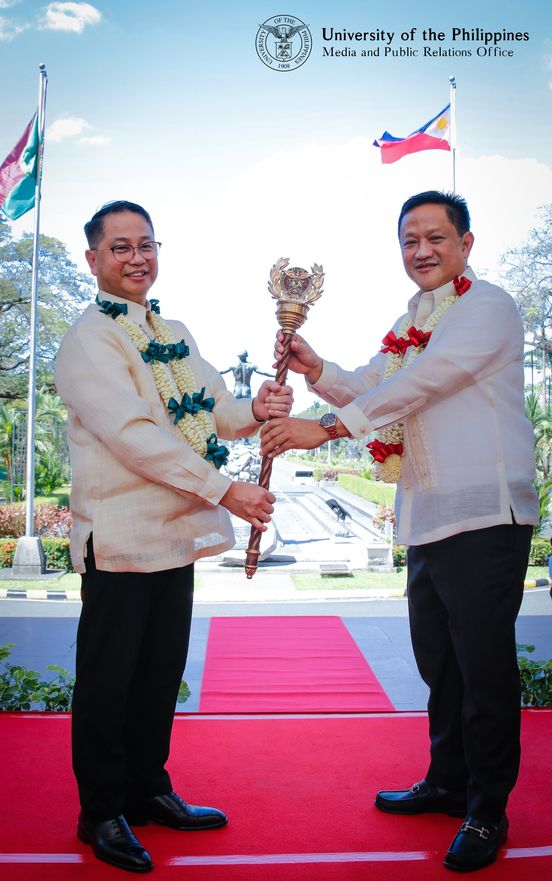

LOOK: Prof. Danilo L. Concepcion, 21st President of the University of the Philippines (UP), passes the mace symbolizing the UP Presidency to his successor, Atty. Angelo A. Jimenez, as he officially starts his term as the 22nd UP President today, February 10, 2023.
The turnover ceremony for the UP Presidency was held this morning at Quezon Hall, UP Diliman, the seat of governance for the national university. It was attended by officials of the UP System, both outgoing and incoming; officials of the different UP campuses; the families of the two UP presidents; members of the UP community; government officials and private sector representatives; and international guests, including members of the diplomatic corps and a delegation of academics from Southern Taiwan representing Edu-Connect Southeast Asia Association from Kaohsiung, Taiwan.
Photos by Misael Bacani, UP MPRO.
Source: University of the Philippines Facebook
UPLB researchers discover new, ‘critically endangered’ tree species in Palawan
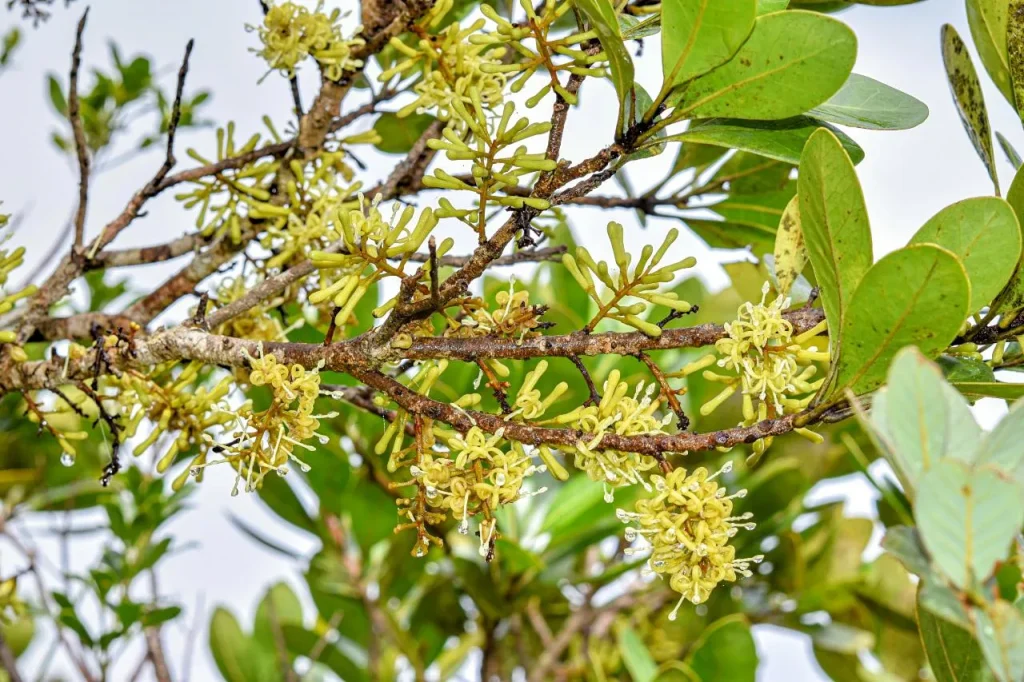
Although its habitat remains unspoiled, Helicia danlagunzadii is suspected of being collected for biological use, leading to its possible population decline
MANILA, Philippines – On the fourth day of a grueling eight-day floristic survey in July 2019, traversing all of Mt. Mantalingahan Protected Landscape (MMPL) in southern Palawan, the researchers saw a bright yellow flowering treelet belonging to the Proteaceae family, glistening even before the crack of dawn.
It was a newly discovered species they named Helicia danlagunzadii.
“Parang sulit ‘yung pagod kasi [noong] unang beses na makita ko, [I know] it’s a new species,” said Pastor Malabrigo Jr., the first author of the study and a plant taxonomy and forest biodiversity professor at the University of the Philippines Los Baños (UPLB).
(When I first saw it, I felt that all the effort was worth it because I know it is a new species.)
The researchers officially described the new species and explained their process in a peer-reviewed journal article, published in the Philippine Journal of Science (formal publication release in April 2023). The study was led by Malabrigo – also the Museum of Natural History’s curator for trees – alongside fellow UPLB researchers Arthur Glenn Umali, Gerald Eduarte, John Ryan Navidad, and Adriane Tobias.
“Kung mapapatubo natin ‘yan sa isang landscape area o urban parks natin, palagay ko, pagkakaguluhan ‘yan,” Malabrigo said on the possible benefits of the newly discovered species.
(I think the public will be excited about it, especially if we can grow the new species in a landscape area or urban parks.)
The bright yellow flowers covering its leafless branches are a sight to behold, ensuring its huge potential not just for aesthetic purposes but for other ecological services as well.
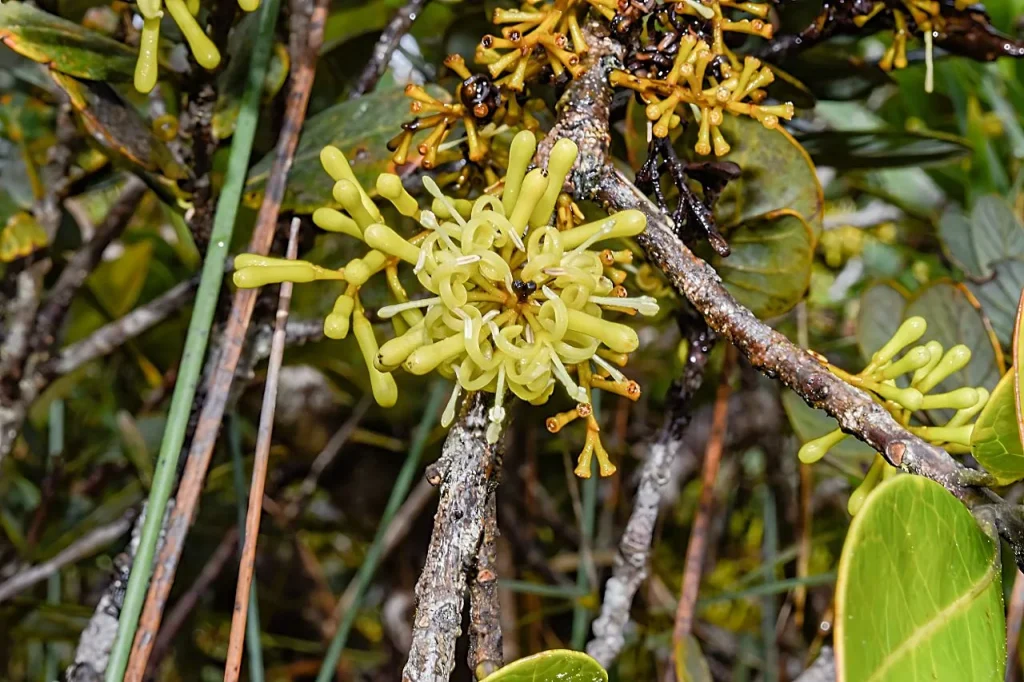
As a close relative of the macadamia tree, H. danlagunzadii has the possibility of producing economically significant fruits due to the predictive power of classification. Malabrigo explained that this is a scientific concept suggesting that related species are likely to have similar properties.
“Biodiversity is directly related to food security,” Tobias said about the importance of the discovery to biodiversity and resilience.
He added that as more humans discover more species, especially those that are potential food sources, the better stability we ensure in having access to adequate food.
Compared to the other five Helicia species found in the Philippines, the new species is unique for its bright shorter clusters of flowers in a branch or set of branches (inflorescences) at 2.5-3.5 centimeters (cm) (vs. 4-32 cm inflorescences of other Helicia species with relatively darker colors) that are often found in pairs.
This flowering treelet or shrub grows up to 4 meters tall, with oval leaves and bright yellowish florets. It has the smallest maximum height among the Helicia species in the Philippines, based on the study.
The researchers chose the name, danlagunzadii, for the new species in honor of Malabrigo’s mentor, Daniel Lagunzad, who was “a great Filipino systematist and ecologist,” according to the study. Lagunzad worked as a professor at the Institute of Biology of the University of the Philippines Diliman, and was known for inspiring his students toward taxonomy and curing people’s plant blindness.
Challenges
However, the researchers, some of whom are assessors for the International Union for Conservation of Nature (IUCN), have assessed H. danlagunzadii under the critically endangered classification of the IUCN Red List.
Their assessment will eventually be approved and added to the updated IUCN Red List website. They acknowledged the possibility of population decline due to the limited number of the said species found in the identified area – a key biodiversity location. Only three matured H. danlagunzadii were observed during the survey.
Although its habitat remains unspoiled, the species is suspected of being collected for biological use, leading to its possible decline. The said species was discovered during a floristic survey in 2019, as part of the project “Enhancing Conservation Actions in Mt. Mantalingahan Protected Landscape” funded and supported by the Forest Foundation Philippines.
“We have the so-called ‘tragedy of the uncommons’ sa (among) trees. Kapag hindi kilala, walang economic value, hindi alam na sa kanila lang makikita, critically endangered, and then pinuputul-putol lang (If it is unknown, has no economic value, and people are unaware that it can only be found in their area and is critically endangered, would likely be cut down),” Malabrigo explained, as most of the locals replace native plants with their misperceived high-value ones.
With 10 vegetative cover types, MMPL is home to more than a hundred threatened species, and the lack of knowledge of a species makes it difficult to impose existing protection laws. Since H. danlagunzadii is located in the transition zone between mossy forest and sub-alpine forest, as well as along the trek path, the new species is likely to have experienced gathering from both locals and tourists.
Rising hope against biodiversity loss
Collected on July 25, 2019, from the highest mountain in Palawan, H. danlagunzadii is crucial to the biodiversity of the said province and the country.
With Palawan as a biodiversity hotspot, which entails high plant endemism and habitat loss, discovering new species provides hope amid biodiversity loss. Biodiversity is crucial for ecosystem resilience and stability – and, essentially, for human survival.
The researchers highlighted the importance of discovering and naming new species, which is the root of all eventual discoveries about their ecological and economic importance to humans.
They said even the locals do not have a name for H. danlagunzadii, suggesting that it has no specific economic value for them. It strengthens the need for more taxonomists in the country, whom they also called “critically endangered” in the country.
“Napakalaki ng ambag nito, hindi lamang sa Palawan at Pilipinas, kundi maging sa buong siyensya (This discovery has a significant contribution, not only to Palawan and the Philippines but also to science),” Umali said about their discovery and the entire process of naming new species.
Malabrigo suggested both in situ (onsite) and ex situ (offsite) conservation strategies to the government and concerned organizations. As a critically endangered species, it falls under a utilization ban to prevent any illegal gathering and protect these species.
More importantly, he pointed out the need for grant-giving institutions to prioritize biodiversity explorations, especially since the Philippines is a megadiverse nation.
“Unless a species is named, hindi mo siya mapapag-aralan,” Malabrigo reiterated. (Unless a species is named, people will never start to study it for further exploration.)
Future studies
Currently, the researchers have already discovered and published four new species from MMPL alone, with another three still undergoing publication review. They excitedly shared that they also have identified 10 new species for further exploration.
With their upcoming book launch in June 2023, in line with the anniversary of the MMPL proclamation, the researchers are excited about the biodiversity research and exploration possibilities in the country.
With the numerous unexplored areas and species in the Philippines, the researchers encourage young people to experience the exciting life and several perks of being a botanist: going to different places, encountering various creatures, and having a significant contribution to science, all while getting paid for it. – Rappler.com
Source: https://www.rappler.com/environment/up-los-banos-researchers-discover-new-critically-endangered-tree-species-palawan/
CFOS Dean Yap appointed to CHED Technical Panel for Fisheries Education
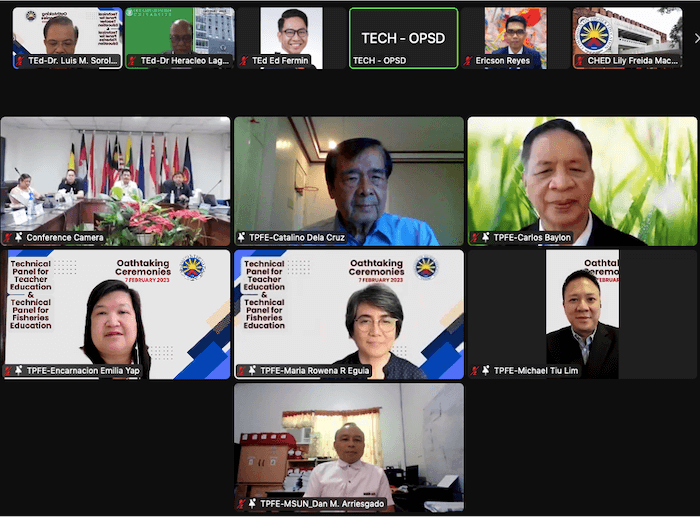
Ms. Lenilyn Gallos
Prof. Encarnacion Emilia S. Yap, dean of the College of Fisheries and Ocean Sciences, UP Visayas, was appointed to the Technical Panel for Fisheries Education of the Commission on Higher Education (CHED).
Yap took oath as a member of the new set of technical panels in a ceremony held online on February 7, 2023.
CHED chairman Dr. J. Prospero E. De Vera III administered the virtual oath-taking of the seven-member team spearheaded by Mr. Michael Tiu Lim as the chairperson. Lim is the Vice President for Business Development of Mega Fishing Corp.
Other members of the said panel are Atty. Gloria E. Ramos (Vice President, Oceana- Phils), Dr. Carlos C. Baylon (Member, PRC Board of Fisheries), Dr. Catalino Dela Cruz (Member, PRC Board of Fisheries), Dr. Maria Rowena R. Equia (Professor, De La Salle University and retired Scientist, SEAFDEC AQD), and Dr. Dan M. Arriesgado (Dean, School of Marine Fisheries and Technology, Mindanao State University – Naawan).
The technical panel is expected to assist CHED in the formulation of policies and standards, and in the evaluation or assessment of higher education institutions (HEIs) and the program offerings.
Members of the technical panel were selected based on their expertise, training, and experience.
Source: https://www.upv.edu.ph/index.php/news/cfos-dean-yap-appointed-to-ched-technical-panel-for-fisheries-education
IPB honors Alma L. Javier with a new gumamela hybrid

To many, the hibiscus or gumamela is a very familiar sight. The flowering plant is a common sight in Filipino gardens and is often overlooked because nothing seems to be new with the often red-colored flower.
But wait, something’s been up at the Institute of Plant Breeding (IPB) – a distinctly new hibiscus hybrid named after a remarkable woman who figured prominently in the life of the man who founded IPB.
IPB launched Hibiscus rosa-sinsensis ‘Alma L. Javier’ in simple rites at the institute on Jan. 31, in gratitude to National Scientist Emil Q. Javier, who founded the institute in 1975, and in honor of his wife, Alma.
She has a noteworthy career as a teacher, guidance counselor, and dedicated mother and wife.
She has been a reliable and steadfast presence in their family, “my rock and anchor,” as Dr. Javier put it.
“She was always there,” recounted Dr. Emil, acknowledging that without her unceasing love and support, he would not have become the Emil Q. Javier that people have come to know today.
Dr. Javier is renowned nationally and internationally for being an institutional builder and visionary leader in agriculture and policymaking, and for being a champion of agriculture modernization.
Developed by IPB breeder Ms. Agripina Rasco, Hibiscus rosa-sinsensis ‘Alma L. Javier’ boasts of striking colors more distinct than the common gumamela.
Its core is a deep fire red, subdued by a soft pink halo that diffuses into warm red-orange. Blanketed with a yellowish sheen, its huge overlapping petals are adorned with delicate pink lines drawing towards its edges. All year round, the flower blooms freely and vigorously.
Hibiscus rosa-sinsensis ‘Alma L. Javier’ was formally presented during the celebration of Dr. Javier and Alma’s 53rd wedding anniversary. UPLB officials, academic dignitaries, relatives, and close friends were present to witness the event. (Juvelle P. Villanueva)
Source: https://uplb.edu.ph/all-news/ipb-honors-alma-l-javier-with-a-new-gumamela-hybrid
De Ungria awarded Rotary Golden Wheel
For her noteworthy research work in forensic DNA technology, Maria Corazon A. de Ungria, PhD, recently received the Rotary Golden Wheel Award for Supporting Education.
Her research in forensic DNA technology served as a tool for human identification in criminal investigation, disaster victim identification, and in resolving parentage disputes.
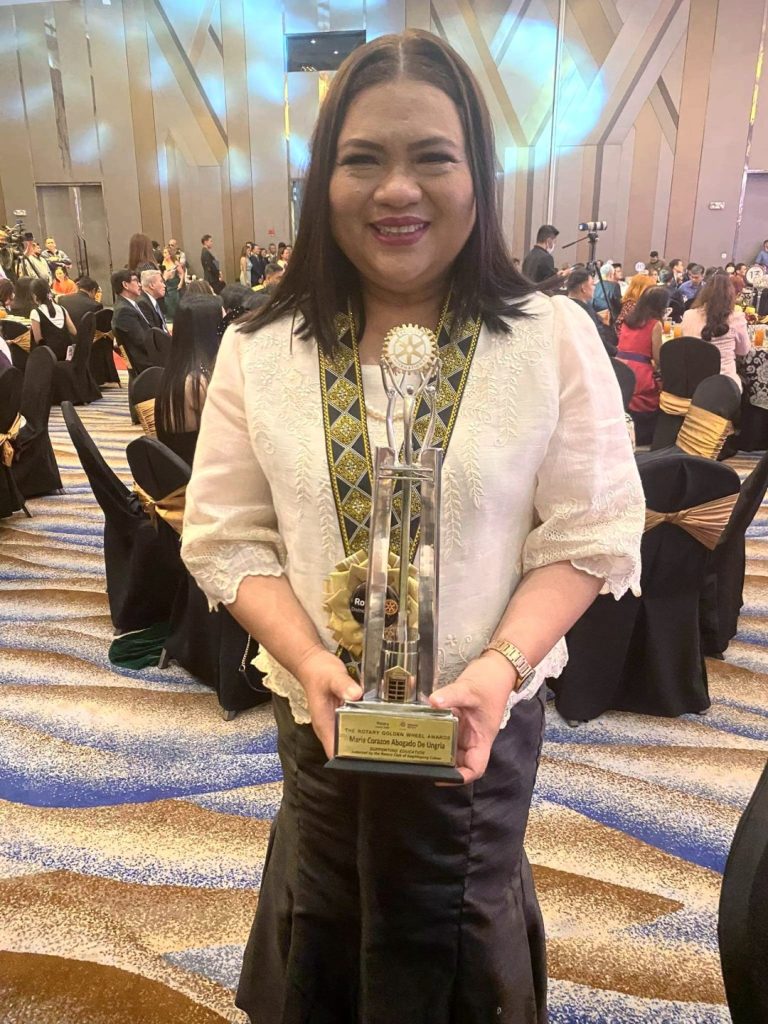

De Ungria, who is head of the DNA Analysis Laboratory of the UP Diliman (UPD) Natural Sciences Research Institute (NSRI), provided technical assistance in drafting the Supreme Court Rule on DNA evidence, which was approved in 2007. This rule has effectively aided the Philippine judicial system in handling sexual assault cases.
The Rotary Golden Award aims to give recognition to non-Rotarians who best exemplify the Rotary spirit of service above self and the guiding principles of the 4 Way Test: Is it the truth?; Is it fair to all concerned?; Will it build goodwill and better friendship?; and Will it be beneficial to all concerned? The award distinguishes men and women in their chosen profession or business for their integrity, dedication, and adherence to high ethical standards.
De Ungria is university researcher V, the highest rank for Research, Extension, and Professional Staff, at the NSRI. She was recently recognized as career scientist 4 under the Department of Science and Technology-Civil Service Commission. She is a professorial lecturer at the UPD College of Science and team-teaches the science in society program and biology 397: current topics in biology (forensic). De Ungria was honored at the Annual Rotary Awards ceremony on Jan. 28 at the Novotel Manila in Araneta Center, Quezon City. The ceremony was organized by the Rotary Club of Kagitingang Cubao, District 3780, in partnership with the Quezon City Local Government.
Source: https://upd.edu.ph/de-ungria-awarded-rotary-golden-wheel
UPLB Professor Emeritus is Rotary Star of Excellence Award recipient

Professor Emeritus Macrina Tamayo-Zafaralla was awarded by the Rotary Club of Alaminos Downtown, Laguna on Jan. 30 with the Gold Award (Non-Rotarian) MC Rotary Star of Excellence Award, for her work as the proponent of Pitsong-Manok Amulungin Biopark and Siway River Biopark in Brgy. San Gregorio in Alaminos town of Laguna.
Prof. Zafaralla conceptualized the Biopark Strategy and the UPLB Aquatic Macrophyte Bioabsorption System (AMBS), a technology designed to help restore water quality using bamboo and native aquatic plants such as water hyacinth or kangkong. AMBS has been operational in bioparks in Tanay, Rizal, and Lipa, Batangas. (Kristel Hope T. Villafuerte)
Source: https://uplb.edu.ph/academic/uplb-professor-emeritus-is-rotary-star-of-excellence-award-recipient
Hokkaido University confers Honorary Doctorate Degree upon Dr. Joel Joseph S. Marciano Jr., Director General, Philippine Space Agency

と寳金総長(右)-1024x683-1.jpg)
Hokkaido University conferred an Honorary Doctorate Degree upon Dr. Joel Joseph S. Marciano Jr., Director General of the Philippine Space Agency in an official ceremony on January 27, 2023. The ceremony was held in the Hokkaido University Conference Hall, and was attended by university officials, faculty, students, and Dr. Marciano’s family from the Philippines.
Dr. Marciano is a renowned expert in the field of Electrical and Electronics Engineering. For more than 20 years, he has made significant contributions to the improvement of Philippines’s advanced science and technology at the University of the Philippines Diliman, the Advanced Science and Technology Institute of the Department of Science and Technology of the Philippines, and the Philippine Space Agency.
Since 2015, he has led the development of micro satellites for scientific earth observation, and together with Hokkaido University, has worked to complete, launch, and subsequently operate the Philippine micro satellites. In March 2020, he went on to become the first Director General of the Philippine Space Agency, and has been committed to the development of space exploration and utilization in the Philippines.
He has also built a stronger relationship with the University by serving as a Hokkaido University Ambassador from 2017 to 2022, participating in the Hokkaido Summer Institute as an invited lecturer since 2016, and even sending Filipino students and researchers for short-term exchanges to the University. In the context of the Memorandum of Understanding concluded between the University and the Philippine Space Agency in March 2022, future exchanges and advancements between Japan and the Philippines aimed at the cultivation of human resources for the space industry at the University are also expected.
Following the conferment ceremony, Dr. Marciano delivered a commemorative lecture titled “Building the Space Value Chain in the Philippines: The Catalytic Role of Hokkaido University and International Cooperation”.
Text and photos provided by Division of International Relations
Source: https://www.global.hokudai.ac.jp/blog/honorary-doctorate-degree-upon-dr-joel-joseph-s-marciano-jr-director-general-philippine-space-agency/
UP Mindanao achieves perfect passing rate at January 2023 Architecture Licensure Exam

The Department of Architecture congratulates the seven BS Architecture alumni who passed the January 2023 Architecture Licensure Exam:
Ar. Annie Rose R. Batayola
Ar. Clarence C. de Guzman
Ar. Dawnelli M. Luar
Ar. Earl Jann M. Ociones
Ar. Vera Philina M. Romuga
Ar. Mia Fatma I. Tilendo
Ar. Kenneth D. Viovicente
UP Mindanao has achieved a 100% passing yet again, with Ar. Luar placing 7th on the licensure exam.
Source: Department of Architecture – UP Mindanao Facebook
Assistant Professor and Chair Kara David wins Best Educational Program Host for Pinas Sarap and Best Documentary Program for I-Witness: The GMA Documentaries in the 35th PMPC Star Awards for Television

Caring for CMC
Mabuhay at padayon kay Assistant Professor and Chair Kara David of the Journalism Department for winning Best Educational Program Host for Pinas Sarap and Best Documentary Program for I-Witness: The GMA Documentaries in the 35th PMPC Star Awards for Television.
Source: UP College of Mass Communication Facebook