Photo from Embassy of the Netherlands in the Philippines
MANILA — A Filipina scientist was bestowed knighthood by the
Netherlands for her work in agriculture and promoting relations there.
Dr. Mary Ann Pelagio Sayoc received the Order of Orange-Nassau and was recognized by Ambassador Saskia de Lang for her efforts.
“The Philippines and The Netherlands have developed strong ties in
the agri-food sector in the areas of trade, investments, agricultural
technology, and knowledge transfer,” the embassy said in a statement.
“I am very proud to announce that it has pleased His Majesty King Willem Alexander to award a Knighthood on a leading personality of the Dutch Filipino community. It is a recognition of exceptional merit to The Netherlands.”
Sayoc serves as the public affairs lead for the East-West Seed Group and head of the Philippine-Dutch Fellows Network, Inc.
She is also a board member Dutch Chamber of Commerce in the
Philippines Inc. since 2014, together with a number of Dutch-Filipino
companies.
“Prior to her move to the seed industry in 1998, Dr. Sayoc was
involved with the International Training Center on Pig Husbandry
(ITCPH), an institution created by The Netherlands government through
Barneveld College and the Philippine government through the Department
of Agriculture-Agricultural Training Institute (DA-ATI),” the embassy
said.
The Order of Orange-Nassau is awarded to individuals for longstanding meritorious service to society, it added.
Fig. 1. Artist’s conception of the three extinct cloud rats, based on their living relatives. From the top, Crateromys, Carpomys, and Batomys. Drawing by Velizar Simeonovski, Field Museum of Natural History.
Three giant cloud rat species were discovered to have lived in the Philippines simultaneously as the oldest human species (Homo luzonensis) found in the country. But two of the rodents went extinct only after 2,000 years ago.
A team from the University of the Philippines (UP), the Philippine
National Museum, and the Field Museum of Natural History of the USA have
since 2017 studied fossil remains sifted from the earth in several
caves in northern Luzon from which they discovered the three extinct
species unique to the Philippines.
The discovery was recently published in the Journal of Mammalogy. Read the full article here.
Fig. 2. Collage of fossil cloud rat teeth. Upper molars of Crateromys new species on the left. Lower mandibles on the right: top, Carpomys new species. Middle, Batomys new species. Bottom, Crateromys new species. Photos by Lauren Nassef, Field Museum of Natural History.Fig. 3. Lower molar teeth of the new giant cloud rat, Carpomys new species (left), compared with the two living species of Carpomys (middle) plus their close relative, Musseromys (right). Photos by Lauren Nassef, Field Museum of Natural History.
“These are three previously unknown species from an unusual group of rodents, locally known as buot or bugkun,
and known in English as giant cloud rats, that live only in the
Philippines,” says Dr. Janine Ochoa, Assistant Professor of Anthropology
of UP Diliman and lead author of the journal paper.
According to the co-author, Dr. Lawrence Heaney, Negaunee Curator of
Mammals at the Field Museum of Natural History in Chicago: “The two that
became extinct [more recently] were giants among rodents, both weighing
about a kilogram. They were big enough that it might have been
worthwhile to hunt and eat them.”
“These giant rats and their relatives are members of an ancient
branch on the tree of life that arrived from the Asian mainland about 14
million years ago and live only in the Philippines,” says co-author
Marian Reyes, a zooarcheologist at the National Museum of the
Philippines.
She describes the buot typically as living in trees and
eating leaves, buds, and seeds. She also says that all of them have
furry or fluffy tails and striking fur colors.
The scientific names of the three new species of fossil cloud rats
were chosen using vernacular terms from Philippine languages. The
largest of the fossil cloud rats is Carpomys dakal, named so because it is much larger compared to the known living species in the same genus, Carpomys melanurus and Carpomys phaeurus. Dakal
means big or large in several languages in northern Luzon, including in
the Itawes, Ibanag and Agta languages. The second fossil species, Crateromys ballik, is slightly smaller than the living Crateromys species on Luzon, Crateromys schadenbergi. Ballik means small in the Dupaningan Agta language. The third species, Batomys cagayanensis, is named after the place where the archaeological sites are located, the Cagayan region of northeastern Luzon.
Fig. 4. Callao Cave interior. Photo by Patricia Cabrera.Fig. 5. Callao Cave excavation. Photo by Armand Mijares.
One of the new fossil rodents is known from only two specimens from
that ancient layer, but the other two are represented by specimens from
that early date up to about 2,000 years ago.
“Our records demonstrate that these giant rodents were able to
survive the profound climatic changes from the Ice Age to current humid
tropics that have impacted the earth over tens of millennia. The
question is, what might have caused their final extinction?” asks Prof.
Philip Piper, a co-author based at the Australian National University
asks.
“A clue might be in that the last recorded occurrence of two of the
species is around 2,000 years ago or shortly after. This is after the
first arrival of agricultural societies and the introduction of animals
like domestic dogs, pigs, and macaque monkeys in Luzon,” co-author Dr.
Armand Mijares of the UP Diliman Archaeological Studies Program, who
headed the excavations of Callao Cave, says.
“While we can’t say for certain based on our current information,
this implies that humans likely played some role in their extinction,”
Mijares argues.
Fig. 6. Dr. Armand Mijares in excavation pit, Callao Cave. Photo by Dawn Satumbaga.
Ancient Philippine biodiversity
According to Ochoa, the extinct mammals previously known from Luzon
were all quite large. They included two types of elephants, a species of
rhinoceros, a giant hog, and relatives of the living dwarf water
buffalo called the tamaraw.
“There has been virtually no information about fossils of
smaller-sized mammals,” she points out. “The reason is probably that
research had focused on open-air sites where the large fossil mammal
faunas were known to have been preserved, rather than the careful
sieving of cave deposits that preserve a broader size-range of
vertebrates including the teeth and bones of rodents,” Ochoa explains.
“Some of these fossils were actually excavated decades ago, in the
1970s and 1980s, and they were in the museum, waiting for someone to
have time to do a detailed study,” says Reyes. “When we began to analyze
the fossil material, we were expecting fossil records for known living
species.”
“To our surprise, we found that we were dealing with not just one but three buot or giant cloud rat species that were previously unknown,” Reyes adds.
“Our previous studies have demonstrated that the Philippines has the
greatest concentration of unique species of mammals of any country, most
of which are small animals, less than 200 grams, that live in the
tropical forest,” Heaney adds. “These recently extinct fossil species
only show that biodiversity was even greater in the very recent past.”
MANILA, Philippines — President Rodrigo Duterte has appointed University of the Philippines Electrical and Electronics Engineering associate professor Dr. Franz Asunta De Leon at the Department of Science and Technology (DOST).
In a statement Thursday, the DOST said De Leon was appointed as director of the agency’s Advanced Science and Technology Institute (ASTI) which leads research and development in the fields of information and communications technology, microelectronics, and space technology.
De Leon was sworn into office this Thursday before DOST Secretary Fortunato Dela Peña at the DOST-ASTI Building in Diliman, Quezon City.
He replaces Dr. Joel Joseph Sacro Marciano Jr. who was earlier named head of the Philippine Space Agency.
“During these challenging times, there is a need for solutions and applications that will uplift our spirits and help us adjust to the new normal. As the new ASTI Director, I want to make the Filipinos enjoy the benefits of innovative solutions in the field of ICT, Microelectronics and Space Technology,” De Leon said, as quoted in the statement.
“We will continue to work closely with our stakeholders to meet their expectations. We will also continue to invest not only in upgrading the facilities, but more importantly in our human resources to be agile and ready for the next generation technologies,” he added.
De Leon earned his bachelor’s degree in electronics and communications engineering in 2003, and his master’s degree in electrical engineering in 2005. He earned his Doctor of Philosophy degree in Electronic and Electrical Engineering at the University of Southampton in the United Kingdom in 2014.
The National Teacher Training Center for the Health Profession wishes Professor Erlyn A. Sana a big congratulations for being the 2021 Recipient of the Award for Exemplary Civilian Service to Philippine Medicine by the Philippine Medical Association!
Your NTTCHP family is very proud of you! #TatakNTTCHP
Dr.
Melinda dela Peña Bandalaria, Chancellor of the University of the
Philippines Open University (UPOU), has been appointed by the
International Council for Distance Education (ICDE) Secretary General
Torunn Gjelsvik as an Ambassador for Open Educational Resources (OER).
She has also been appointed as a member of the ICDE OER Advisory
Committee (OERAC). These appointments are valid for two years and until
the end of 2022.
The OERAC
was created with the objective of increasing global recognition of OER
and to provide policy support for the uptake, use and reuse of OER. The
main task of the committee members and ambassadors of OER is to to
support the implementation of the United Nations Educational, Scientific and Cultural Organization (UNESCO) OER recommendations as well as the monitoring and evaluation activities.
The current advisory committee is constituted by representatives from six different world regions. These
are Jane-Frances Obiageli Agbu of the National Open University of
Nigeria, Nigeria; Mpine Makoe of the University of South Africa, South
Africa; Xiangyang Zhang of the Jiangsu Open University, China; Daniel
Burgos of the International University of La Rioja, Spain; Ebba
Ossiannilsson of the Swedish Association Distance Education, Sweden;
Cengiz Hakan Aydin of the Anadolu University, Turkey; Cristine M G
Gusmão of the Rio Grande Do Norte Federal University, Brazil; Rosa
Leonor Ulloa Cazarez of the Guadalajara University, Mexico; Constance
Blomgren of the Athabasca University, Canada; and Yi Yang of Franklin
University, USA.
Dr. Bandalaria is an active advocate of open education. She has been engaged in Open Educational Resource and Practices since 2017 and has led various programs and projects on this topic. Chancellor Bandalaria is also known for her leadership in open education initiatives, being the Chair of the Asian MOOCs Steering Committee, and the Co-Chair of the OER Dynamic Coalition Advisory Board on Quality, Inclusive Multilingualism.
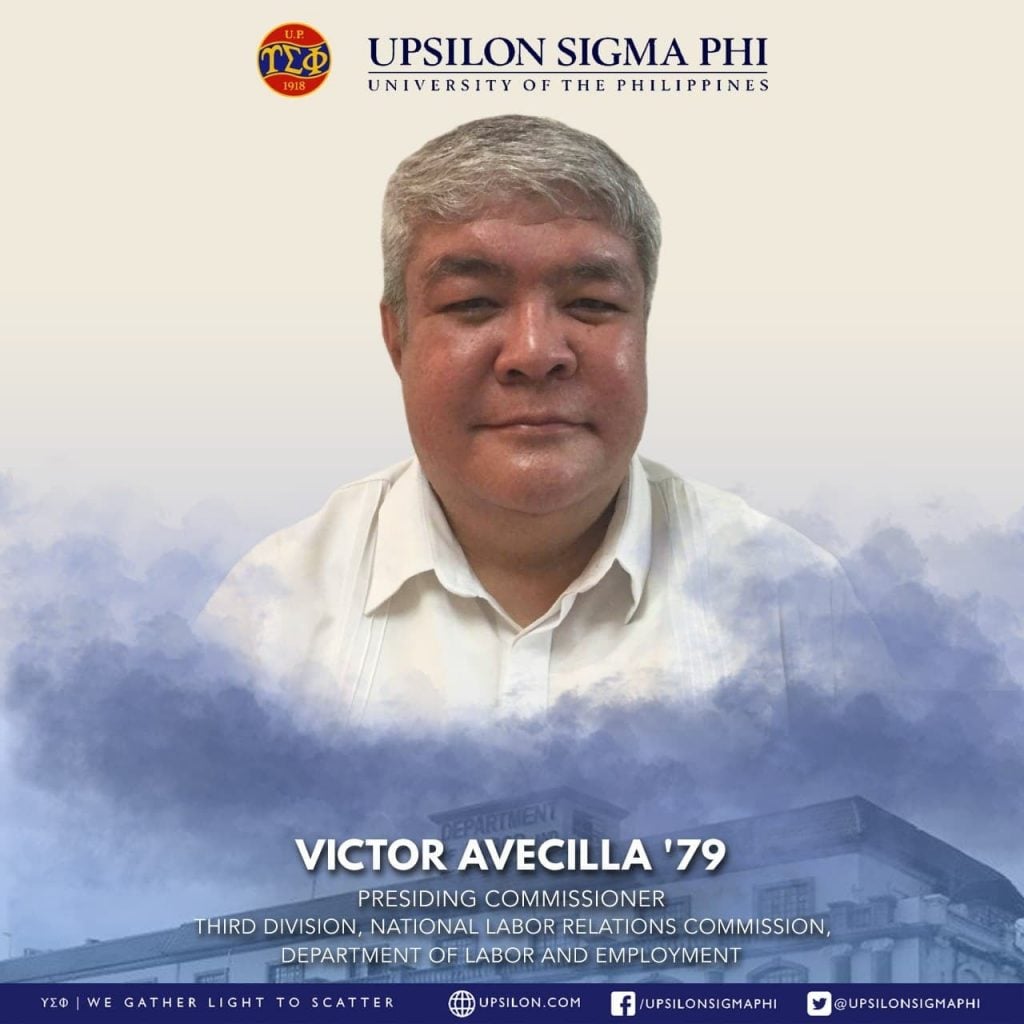
The Upsilon Sigma Phi congratulates Atty. Victor Avecilla ‘79 for his appointment as the Presiding Commissioner of the Third Division of the National Labor Relations Commission (NLRC).
The NLRC is a quasi-judicial agency attached to the Department of Labor and Employment. It is mandated to adjudicate labor and management disputes involving local and overseas workers.
Fellow Victor concurrently serves as a columnist for the Daily Tribune. He has been an assistant professor in the UP College of Mass Communication since 1992.
He holds a bachelor’s degree in Broadcast Communication from the UP College of Mass Communication and a Juris Doctor degree from the UP College of Law.
Dr.
Deo Florence L. Onda, a microbial oceanographer of The Marine Science
Institute, University of the Philippines is set to make history as one
of the first humans and the first Filipino to reach the 3rd deepest spot
on earth, located in the Philippine Trench called the Emden Deep which
is approximately 10,400 m or 34,100 ft deep. Dr. Onda was invited by the
organization Caladan Oceanic to join the Emden Deep Expedition targeted
on March 22 to 28, 2021. He will be joined in the descent by Mr. Victor
Vescovo, the current record holder of the deepest manned descent in the
Marianas Trench in 2019. Mr. Vescovo is also the main sponsor of
Caladan Oceanic, which is a private organization that has been setting
records for deepest manned descents in the world’s deepest trenches,
with the most recent one in the Marianas in 2019.
Deep
sea expeditions like this one are equivalent to the first early flights
into outer space, thus it would be a major record-setting scientific
and historic achievement. To date, most of these records are held by
foreign scientists or explorers. The Philippine Trench is a unique
feature found within the EEZ of the Philippines, and it is only
appropriate that a Filipino scientist be one of the first to hold this
record in the Emden Deep.
Dr.
Onda and Mr. Vescovo will dive the Emden Deep onboard the DSSV Pressure
Drop, the only marine vessel in the world capable of launching the
deep-sea submersible DSV Limiting Factor that can carry humans and
repeatedly dive to the deepest parts in the world’s oceans.
Part
of the goal is to wave the Philippine Flag in the Emden Deep during its
record-setting voyage, highlighting that it is an integral part of our
nation’s heritage. Dr. Onda, as the sole Filipino researcher
representing the country, will also be given a unique opportunity to be
exposed to state-of-the-art vessels capable of deep-sea activities,
which can enrich our experiences and knowledge as the Philippines builds
its own National Academic Research Fleet (NARFleet), an ongoing
national project funded by the Philippine Government. This endeavor can
spark interest and passion for many other young Filipinos who would want
to make a career in the sciences and bring more attention to the
protection, preservation, and conservation of the Philippine marine
environment.
Dr.
Onda is now onboard the DSSV Pressure Drop and will start the voyage
from the port of Guam to the Philippine Trench. This activity has been
fully coordinated with the Philippine Government through the Department
of Foreign Affairs and is considered a non-Marine Scientific Research
(MSR) activity.
For more information, please send inquiries to [email protected],ph/ (632) 922-3962, (632) 981-8500 local 2902 or email Mr. Rob McCallum ([email protected]), the expedition leader of the Caladan Expedition.
The Upsilon Sigma Phi of the University of the Philippines in late February honored 11 of its alumni with the Upsilonian, Noble and Outstanding or UNO awards.
This year’s UNO awardees are community development guru Nestor M. Pestelos, a political detainee during Martial Law; and retired General Gregorio Pio Catapang, former AFP chief of staff; retired Colonel Nereo C. Andolong, past Philippine Olympic Committee Chairman and PCSO General Manager; US based physicians, Dr. Emmanuel A. Lat and Dr. William E. Romero, both past Presidents of the UP Medical Alumni Society of America; entrepreneur Ray A. Orozco; former Unilever executive Jose “Pong” Ejercito; More Power President Roel Castro; the late former DBP chairman Ramoncito Z. Abad; the late news anchor Angelo Y. Castro Jr.; and the late Capiz Representative Gerardo A. Roxas Jr.
The awarding ceremonies were conducted online during the biennial Upsilon Congress, which itself was conducted via Zoom due to health protocols amid the COVID-19 pandemic.
The Upsilon Congress ushered in the new leadership in in the USP Alumni Association of House Majority Leader Martin Romualdez as chairman and Unilever Philippines executive Ed Sunico as president.
The other new officials are Myki Cantero, vice president; Bong Uichangco, treasurer; and Atty. Eric Pilapil, corporate secretary.
Members of the new Board of Directors and Trustees include Dr. Bill Romero, Ricky Marcelo, Roel Castro, Bong Manlulu, Lewis Yu, Dr. Alan Austriaco, Gari Tiongco, Dennis Gelacio, Atty. Jorenz Tañada, Jon Javier, Atty. Poli Policarpio 2000, Atty. Jeff Coronel, and Alaine Gonzales.
The Upsilon Sigma Phi is recognized as the oldest Greek-letter society in Asia and is based solely in the State University’s primary campuses, UP Diliman/UP Manila and UP Los Banos.
It celebrated its centennial in 2018.
From Upsilon Sigma Phi Alumni Association press release
Written by Rowena N. Peter and Mary Charlotte O. Fresco
“Nothing great was ever achieved without enthusiasm.”(Ralph Waldo Emerson, American Philosopher)
In time for its 88th General
Membership Assembly, National Research Council of the Philippines
(NRCP), the country’s premier agency for basic and fundamental research
and the largest collegial body, has named its member-awardees and member
emeriti as the recipients of the 2020 NRCP Awards.
Seven (7) NRCP Regular Members
(researchers) were carefully chosen as awardees and will be conferred
the NRCP Achievement Award, the highest recognition bestowed by the
Council since 1979 on its members whose works greatly contributed to the
advancement of their respective fields of expertise and responded to
the needs and challenges of various industries.
Two (2) awardees will also receive the
NRCP Member Emeritus Award which is given in recognition of the member’s
distinguished lifetime accomplishments in research and for mentoring
younger scientists and researchers.
Indeed, more than their works, is the
enthusiasm they demonstrate in sharing their expertise and continued
advocacy in encouraging the young to get into research and eventually
contribute to the development goals of the country.
The official presentation of the awardees will be part of the NRCP Annual Scientific Conference and 88th General Membership Assembly on March 10, 2021 via an online platform.
The 2020 NRCP Achievement Awardees per scientific division are the following:
Division of Mathematical Sciences
JOSE ERNIE C. LOPE, Ph.D. Full Professor, Institute of Mathematics University of the Philippines Diliman
Dr. Lope is one of the foremost experts
in the area of partial differential equations, contributing both to
theory and applications. He has distinguished himself through his
significant and numerous research publications in high-quality
international and national journals. He serves key positions in research
and professional organizations including National Board Member and the
current Vice-President of the Mathematical Society of the Philippines.
He has received prestigious awards for his research and teaching, such
as appointment to the UP Scientist I position, the UP Diliman Gawad
Chanselor para sa Natatanging Guro, National Academy of Science and
Technology Outstanding Young Scientist Award, NAST-The World Academy of
Sciences Young Scientist Award and first prize in the NAST-Du Pont
Talent Search for Young Scientists. He has successfully mentored numerous students at all levels.
Division of Biological Sciences
VACHEL GAY VELASCO PALLER, Ph.D. Professor of the Institute of Biological Sciences University of the Philippines Los Baños
Dr. Paller is a distinguished expert
whose advocacy and contributions in the field of parasitology research
have fostered interdisciplinary and interagency approaches in addressing
parasite control and prevention in poor-resource communities in the
country. Her advocacy in promoting ONE HEALTH through evidence-based
research, teaching, and extension has fostered interagency and
international partnerships, improved academic curriculum, and capacity
building of higher education institutions and local communities to
improve ecosystem, animal, and human health. She was hailed as one of
the UPLB Outstanding Alumni awardees in 2014, awarded the UP Scientist
III title, the UPLB Outstanding Teacher in Biological Sciences in 2016,
the UPLB College of Arts and Sciences Outstanding Researcher Award in
2020, and the One UP Professorial Chair Award for 2016-2021. She has
published over 50 original scientific articles in high-impact journals.She
also exemplifies excellent leadership and mentoring with the
exceptional ability to inspire her colleagues and students to uphold the
ideals of honor, excellence, and service. She authored NRCP Monograph
titled “Fish Parasites as Heavy Metal Absorbents” and was the project
leader of the NRCP-funded project “Diversity and Ecology of
Acanthocephalan Parasites in Freshwater Fishes from the Seven Lakes of
San Pablo City, Philippines and their Potential as Heavy Metal
Bioindicators.”
Division of Agriculture and Forestry
RAMON A. RAZAL, Ph.D. Professor 12 at the College of Forestry and Natural Resources University of the Philippines Los Baños
Dr. Razal is a distinguished researcher
whose work on non-timber forest products such as bamboo and resin
contributed greatly to enriching knowledge and providing policy support
to improve the lives of people in forest communities. He has published
numerous scientific papers in indexed and peer-reviewed journals, books
and book chapters, and technical reports. He is also
an accomplished administrator and teacher and received awards such as
the 2020 UPLB Outstanding Senior Researcher in Natural Sciences Award,
the 2019 Kapisanang Kimika ng Pilipinas – Southern Tagalog Chapter
Distinguished Achievement Award in Research, and the 1999 UPLB
Outstanding Teacher Award in Physical Science, among others. He shares
his technical expertise by conducting training and giving lectures to a
wide array of audience and participants. He served as the Chair of
NRCP’s Agriculture and Forestry Division from 2016-2020 and as NRCP
President from 2018-2020.
Division of Engineering and Industrial Research
ARISTOTLE T. UBANDO, Ph.D. Full Professor and Research Fellow Mechanical Engineering Department De La Salle University
Dr. Ubando’s research works focus on
finite element analysis, computational fluid dynamics, process
integration and optimization, and energy system modelling. He has
published more than 120 Scopus-indexed journal papers in the national
and international level with an h-index of 13. He is selected as one of
the 2017 Asian Scientist 100 for his contribution in the sustainability
field. He is a multi-awarded scientist in the Philippines, among his
national awards is the Outstanding Young Scientist in 2016 bestowed by
NAST Philippines. He is also a recipient of the Fulbright Scholarship
Program at the University of Arizona and Texas A&M University in
2013. Prof. Ubando has been engaged as an RD Leader under the RD
Leadership program being implemented by NRCP for the development of
Mindanao Renewable Energy R&D Center.
Division of Physics
JINKY BAUTISTA BORNALES, Ph.D. Vice-Chancellor for Research and Extension Mindanao State University-Iligan Institute of Technology
Professor Bornales is among the foremost
experts in the application of path summation and white noise functional
techniques applied to quantum and biomolecular systems. She has applied
these methods in contexts such as fermions in Aharonov-Bohm-Coulomb
systems, polymer entanglements, fractional Brownian motion, and
biomolecular transport. She has actively been engaged in administration
work, having served as Chair of the Physics Department, Dean of the
College of Science and Mathematics, and President of the Samahang Pisika
ng Visayas in Mindanao (SPVM). She has led projects such as
Establishment of Center of Innovation and Technopreneurship (CIT) at
MSU-IIT and TBI 4.0: Mindanao SCALE UP Program for DOST-iDEYA TBI.
She heads the FABLab Mindanao and heads the MoCoS (Modeling Corona
Spread) Philippine Team, and is a member of the Scientific Board of the
Institute for Research Innovation and Scholarship and is the current
Vice Chancellor for Research and Extension of MSU-IIT.
Division of Humanities
JOSE WENDELL P. CAPILI, Ph.D. Assistant Vice-President for Public Affairs Director of Alumni Relations University of the Philippines Diliman
Dr. Capili is a Professor of English,
creative writing and comparative literature at the College of Arts and
Letters, UP Diliman. His works were published in Asia, Europe, North
America, and Australia. He has held various administrative posts across
the UP System since 1997. He was a recipient of the National Book Award
(Literary History/Literary Criticism, 2017), the Carlos Palanca Memorial
Award for Literature (Essay, 1996), the Cultural Center of the
Philippines Award for Literature (Poetry, 1993), the UP International
Publication Award (2001), the UP Diliman Gawad Chancellor (1998), the UP
System Outstanding Student Artist Award (1989), the UP System Creative
Writing Grant (2003), the UP Carlos P. Romulo Professorial Chair (1998,
2000), the UP Centennial Professorial Chair (2009, 2010, 2011, 2017),
and the One UP Professorial Chair for Teaching and Research (2016, 2017,
2018, 2019, 2020, 2021), as well as various scholarships, grants and
fellowships.
Division of Earth and Space Sciences
BETCHAIDA D. PAYOT, Ph.D. Assistant Professor National Institute of Geological Sciences University of the Philippines Diliman
Dr. Payot is an expert in igneous
petrology and geochemistry whose works significantly contributed to the
understanding of the origin and the processes involved in the formation
of igneous rock suites called “ophiolites” in different parts of the
Philippines. Some of her most notable works include elucidating the
evolution of several Philippines islands through petrological and
geochemical analyses of ophiolitic rocks in Pujada peninsula, and
Palawan, among others. Her research on xenoliths hosted by volcanic
rocks in Mt. Pinatubo, the Batanes group of islands and in Baguio also
shed light to magmatic and metasomatic processes in the Luzon arc. Aside
from her active involvement in geological research in the Philippines,
she also currently serves as one of the Board of Trustees of the
Geological Society of the Philippines (GSP). Dr. Payot is actively
involved in other extension services that aim to bring science closer to
the masses through information and education campaigns and various
lectures and workshops on geohazards.
The 2020 NRCP Member Emeriti are the following:
Cluster 1
BELEN TAN-GATUE MEDINA Retired Professor Department of Sociology University of the Philippines Diliman
Professor Medina is the recognized
expert in the sociology of the family and the author of the only
textbook on this topic in the country, The Filipino Family, published by
the UP Press (3rd Edition, 2015). Her other works are on emerging
structures and arrangements in families, marriage patterns among
slum-dwellers, intermarriage, fragility of marriage and other marital
problems, chain migration of families to the United States, outmigration
of village families, and the Filipino elderly.
Professor Medina served for more than
half a century as a founding member and officer of the Philippine
Sociological Society and as pioneering faculty member of the UP Diliman
Department of Sociology, and has contributed to the professional growth
of several generations of sociologists, now at the helm as institutional
leaders in the country.
Cluster 4
CEFERINO P. MAALA, DVM, Ph.D. NAST Academician Professor Emeritus University of the Philippines Los Baños
Dr. Maala is an expert in veterinary anatomy specially that of the water buffalo. His researches on the anatomy of the Philippine water buffalo have significantly contributed to the improvement of the Philippine water buffalo production in the country. Among the monitoring works of Dr. Maala include the muzzle and palatine printing method which could be adapted as alternative methods in the identification of the Philippine water buffalo. Despite having retired from teaching, Dr. Maala is still actively involved in teaching graduate courses as well as serving as thesis adviser to undergraduate and graduate DVM students. He has just organized the Philippine Association of Veterinary Anatomists (PAVA) and was elected its first President. In recognition of his exemplary accomplishments in teaching and research, Dr. Maala has been honored Outstanding Teacher and Researcher Awards in Veterinary Medicine by various professional and scientific groups in the country.
The Alpha Phi Omega Sorority – Eta Chapter would like to congratulate our sister, Atty. Dahlia B. Salamat, for being elected as the Vice President for the Integrated Bar of the Philippines, Zambales Chapter.
May you continue to uphold Leadership, Friendship, and Service in all your endeavors. We’re very proud of you!
You may choose not to have a unique web analytics cookie identification number assigned to your computer to avoid the aggregation and analysis of data collected on this website.
To make that choice, please click below to receive an opt-out cookie.