

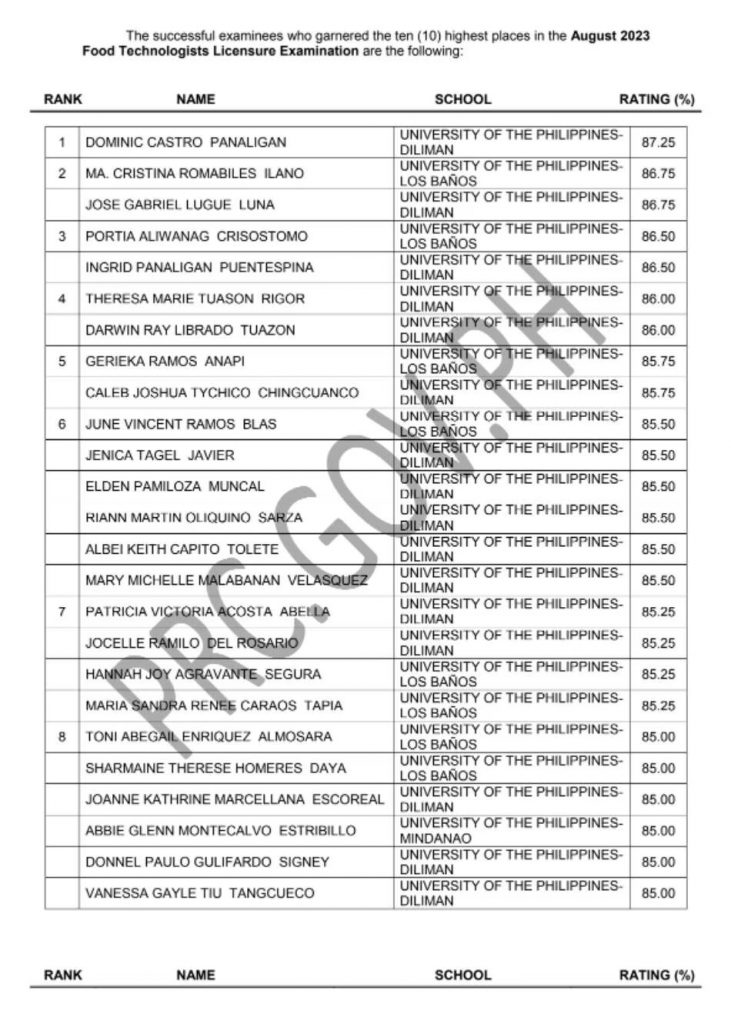

MANILA — The Professional Regulation Commission (PRC) announced Wednesday that 453 out of 1,133 takers passed the Food Technologists Licensure Examination given this month.
Dominic Castro Panaligan of the University of the Philippines Diliman placed first with an 87.25 percent score rating.
Ma. Christina Romabiles Ilano of UP Los Baños and Jose Gabriel Lugue Luna of UP Diliman tied for second place with a rating of 86.75.
UP Diliman was also named top performing school with a 100 percent passing rate.
Source: https://news.abs-cbn.com/news/08/16/23/up-diliman-uplb-grads-top-1st-food-technology-board-exams
Alumni Milestones
BSP Deputy Governor Mamerto Tangonan Encourages UPCOE Class of 2023
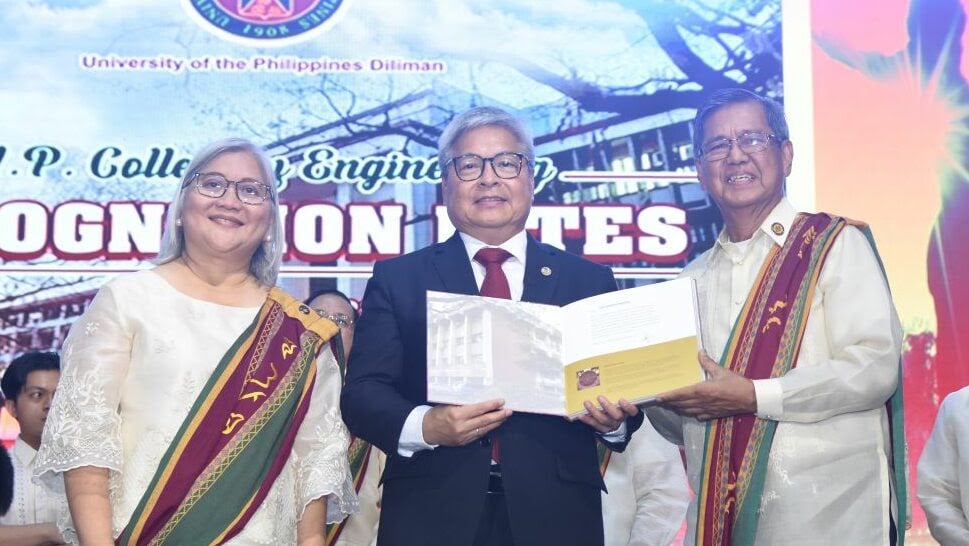
The UP College of Engineering held the Recognition Rites on August 1, 2023 at the Cuneta Astrodome, Pasay City. The guest speaker was UPERDFI Member Mamerto “Mert” E. Tangonan from the BS Civil Engineering Class of 1984. Mert is the Deputy Governor of the Payments and Currency Management Sector of the Bangko Sentral ng Pilipinas. He greeted the thousands of young engineers from the Class of 2023, 2022, and 2021, together with their proud parents and grandparents.
He encouraged the graduates to pursue their dreams, working as entrepreneurs or in companies in their fields. They will experience bumps along the way, but their UP education should enable them to overcome these and succeed. He made a special request, that the graduates explore working with public-sector agencies, as these need bright minds to move things forward. He plugged that the BSP is a great place to do great work, as it is at the forefront of innovations in the digital payments space.
UPCOE Class of 2023 comprises of 876 graduates from the twelve Bachelor of Science degree programs of the College of Engineering. This is a gifted class, with 503 (67%) finishing with honors. There are 174 cum laude, 303 magna cum laude, and 106 summa cum laude. The Class Valedictorian (graduate with the highest GWA, 1.027), is Caelan Joseph Consing, a Mechanical Engineering major. UPERDFI gifted him with our Golden Anniversary Book.
Source: In the Loop August 2023 Issue (UP Engineering Research and Development Foundation, Inc. Newsletter)
DOST PCIEERD Executive Director Dr. Enrico Paringit Poses Challenge to NGSE Graduates
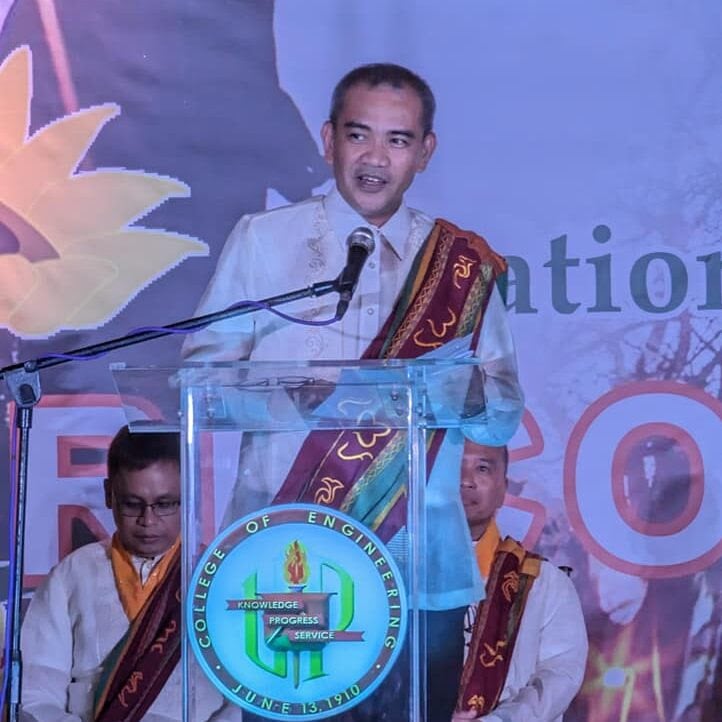
The UP College of Engineering National Graduate School for Engineering held its Recognition Rites on July 27, 2023, at the Bahay ng Alumni, Quezon City. The guest speaker was UPERDFI Trustee Dr. Enrico “Eric” Paringit, BS Geodetic Engineering (1997) and MS Remote Sensing (1999). He finished his D.Eng degree at the Tokyo Institute of Technology. He was a key scientist in DOST Project NOAH and the DOST DREAM LIDAR Project.
He admonished the MS and Ph.D. graduates to transform the country by undertaking research and development work. He reminded them to forge collaborations with partners in other disciplines so that holistic solutions may be germinated, and then thrive in a changing society. He cited that NGSE graduates should be creators of innovation that impact society.
The NGSE Class of 2023 is composed of 10 PhDs and 100 MS graduates. Alfonso Labao, a Ph.D. in Computer Science graduate, was the Class Standard Bearer and was gifted with the UPERDI Golden Anniversary Book. He will join the DCS faculty team.
Source: In the Loop August 2023 Issue (UP Engineering Research and Development Foundation, Inc. Newsletter)
UP Tacloban obtains 100% passing rate in the 2023 Board Licensure Exam for Psychometricians
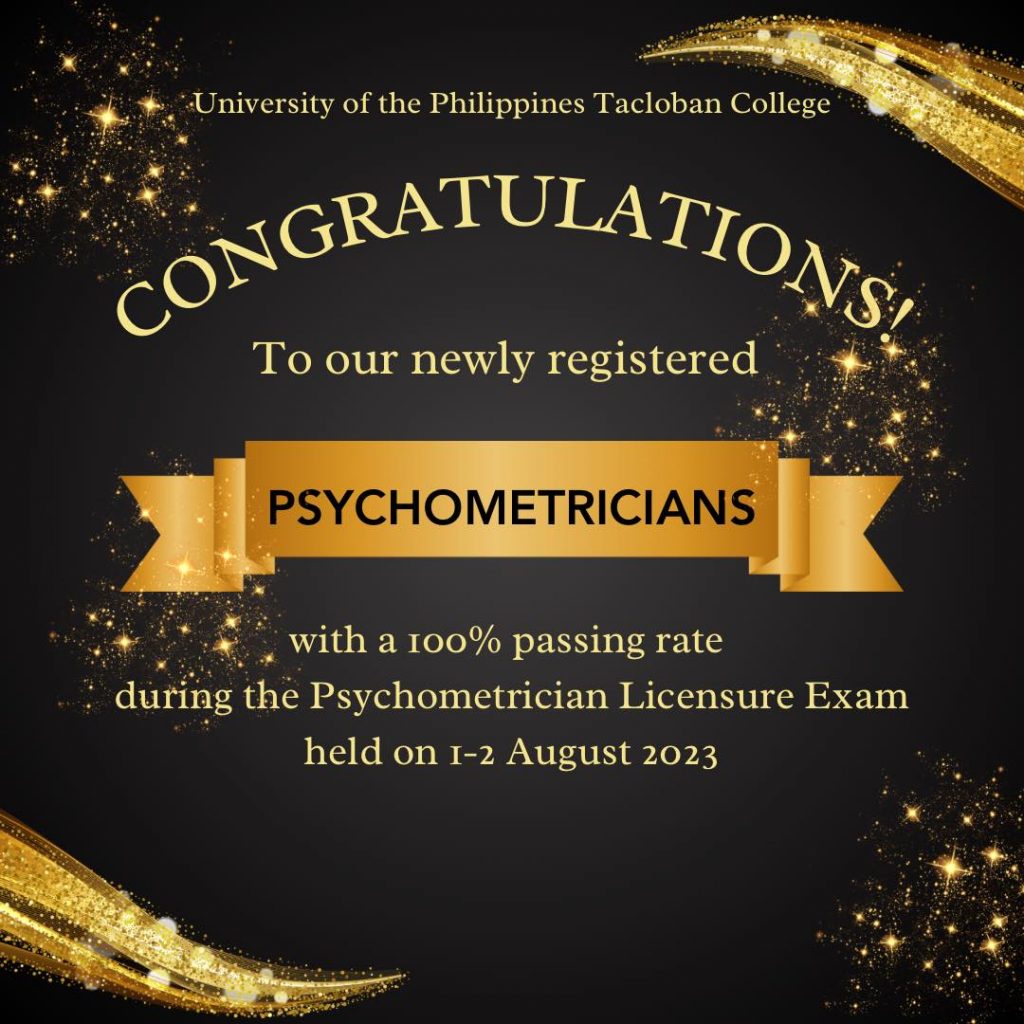
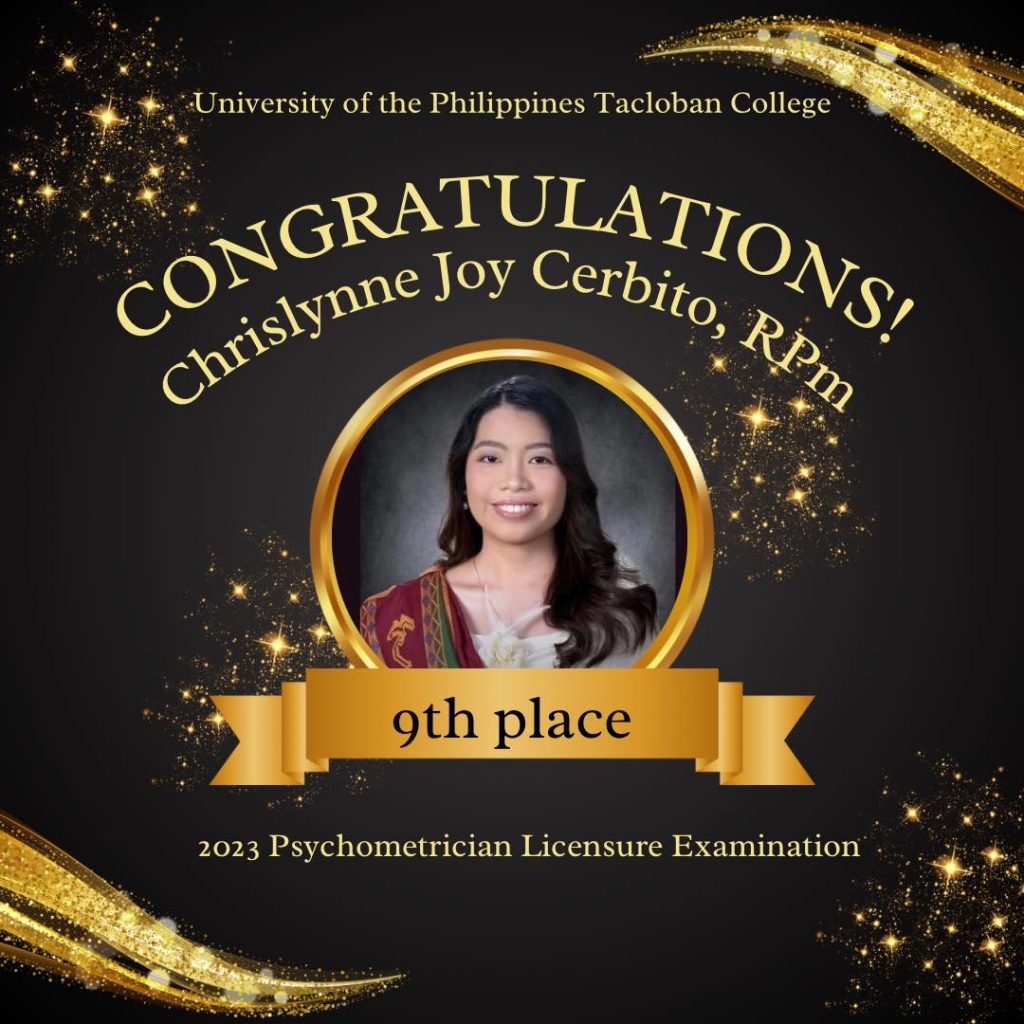
Congratulations to our newly registered Psychometricians for obtaining a 100% passing rate in the 2023 Board Licensure Exam for Psychometricians and producing a 9th placer – Chrislynne Joy Cerbito.
Source: UP Tacloban College – Division of Social Sciences Facebook
3 psych grads rank 9th in Psychometrician Licensure Exam; UPV scores 100% passing rate
Mr. Carlson Alelis

Three Bachelor of Arts in Psychology graduates of the University of the Philippines Visayas (UPV) ranked 9th in the August 2023 Psychometrician Licensure Examination.
Yziel Gale Alagos, Jhio Jan Navarro, and Carla Angela Ladrido are the top-notchers of the said examination, according to the Psychology Cluster, Division of Social Sciences, of the UPV College of Arts and Sciences.
Meanwhile, UPV obtained a 100 percent passing rate for the examination. The set of new Registered Psychometricians includes:
• Khent Adenix
• Julia Selah Sontillanosa
• Yumi Ilagan
• Nicole Marie Bolinas
• Yziel Gale Alagos
• Genevieve Nanta
• Christine Joy Atun
• Ma. Diana Rose Ladoc
• Alethea Van Loren Estilo
• Michelle Florence Rivera
• Jhio Jan Navarro
• ML Farinas
• Anna Lou Gulbique
• Angelica Anne Monteclaro
• Perlyn Joyce Pano
• Xyra Mae Melendres
• Carla Angela Ladrido
• Lyrra Tolentino
• Chinky Ann Buhayan
Navarro and Adenix are currently instructors under the UPV Psychology Cluster.
The Professional Regulation Commission (PRC) released the results of the examination on Wednesday, Aug. 9. Out of the 8,370 who took the exam, 6,133 passed.
The Psychology Cluster likewise congratulated their former instructor, Ms. Jessicca Mae Dee, and former lecturer, Ms. Tricia Denise Zafra, for topping the Psychologists Licensure Examination, released on the same day. Dee and Zafra ranked first and second, respectively. (With sources from Psychology Cluster and PRC)
Source: https://www.upv.edu.ph/index.php/news/3-psych-grads-rank-9th-in-psychometrician-licensure-exam-upv-scores-100-passing-rate
UP celebrates record number of scientists in almost half a century
Written by UPD-CS Science Communications team
The University of the Philippines – Diliman College of Science (UPD-CS) is poised to make unprecedented contributions to Filipino science and the collective body of human knowledge as it recently posted the most PhD graduates ever in its decades-long history.
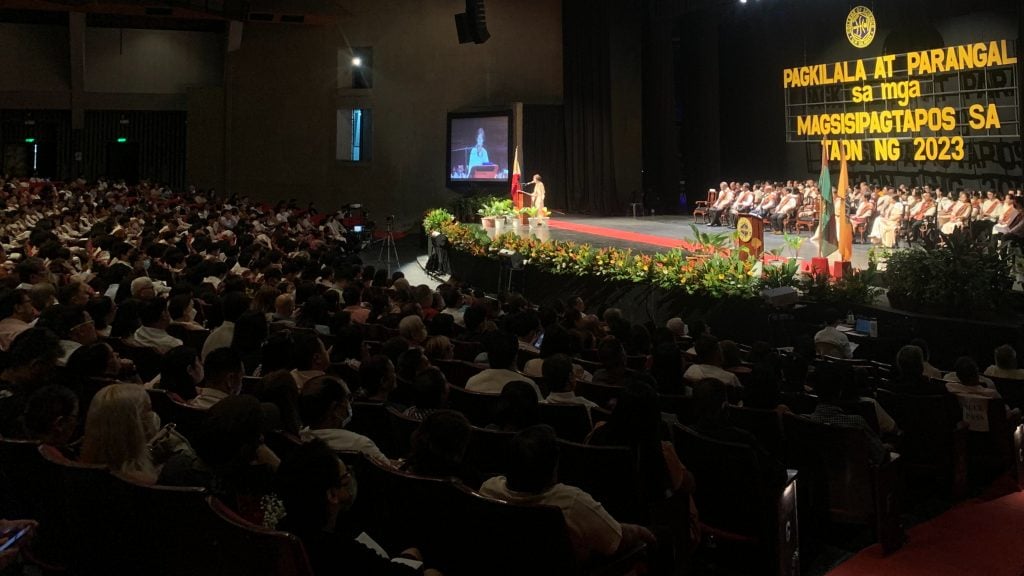
A total of 454 newly-minted graduates celebrated the fruits of their labor on the rainy Saturday afternoon of July 29. Among them were 19 PhD graduates, 108 MS graduates, seven MA graduates, three Professional Masters, five diploma recipients, and 312 BS graduates. The number of UPD-CS’ PhD graduates for 2023 is also almost double that of the previous year.
The number of PhD enrollees at UPD-CS has been consistently on the rise every year, with last year’s count reaching 464. UPD-CS’ nine institutes and programs continue to offer a total of 11 doctorate degrees, including the recently-offered PhD in Data Science.
UPD-CS Dean Dr. Giovanni A. Tapang beamed with pride as he welcomed the graduating students, their parents, and guests during the CS Special Recognition Program 2023 at the UP Theater. “This is the most number of PhD graduates we’ve had in CS’ forty-year history,” he said.
The long road taken
Dr. Bernard Alan B. Racoma, this year’s Most Outstanding PhD Graduate from the UPD-CS Institute of Environmental Science and Meteorology (IESM) spoke on behalf of the graduate students, extolling the virtue of taking the long view to one’s goals despite—and even amid—setbacks.
“There shouldn’t be shame when we take a long time in our studies, be it in graduate or undergraduate education. When this happens, more often than not, there are reasons behind it,” he said. “Just like there are reasons why clouds form and it rains, there are always valid reasons why students fall behind, give up, get delayed, or drop out.”
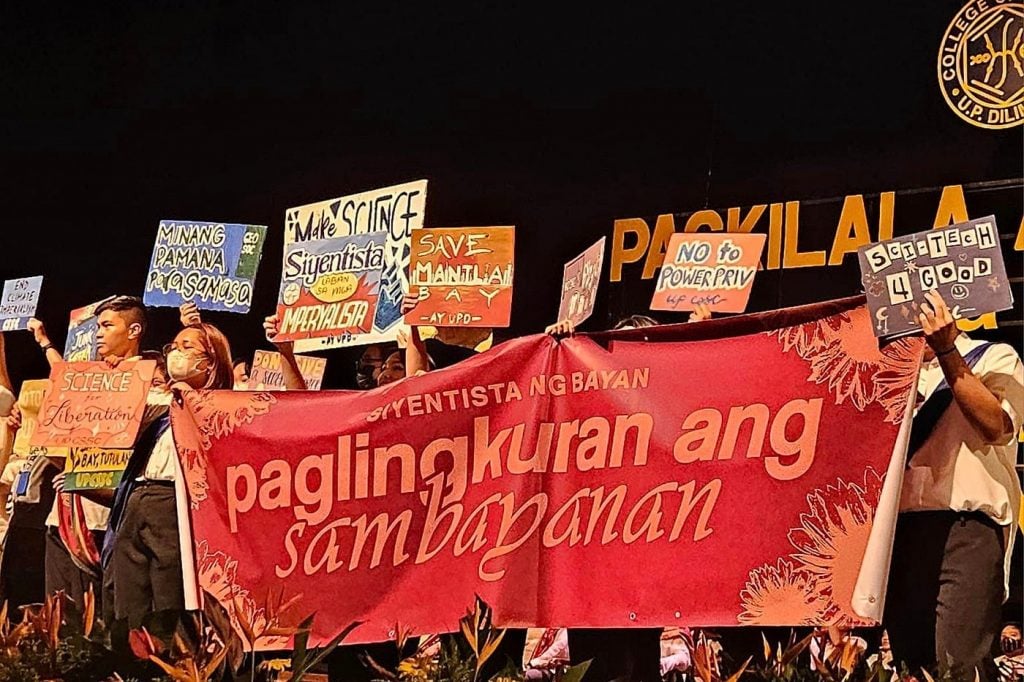
“Graduates of 2023, let’s make it rain. Mabuhay po tayong lahat, mabuhay ang mga siyentista ng bayan. Patuloy nating pagsilbihan ang isa’t isa, patuloy nating pagsilbihan ang taumbayan,” he concluded.
Science within reach of everyone
These sentiments were echoed by BS Physics graduate summa cum laude Mary June Ricaña in her own remarks on behalf of her undergraduate class:
“As of 2019, the Philippines only has 189 scientists per million people—a far cry from the ideal ratio of 380 per million population,” she said. “The truth is, science should not be so difficult to pursue. It should be an arm’s reach to every child who ever looked at the night sky and dreamed of one day exploring galaxies.”
“After today, we will be taking different paths, but we should always remember whom we owe all of these to, and whom all these are for. The world is a laboratory; it is imperative for us to find scientific solutions to problems faced by society. Graduating batch of 2023, let us make science serve the people,” she added.
Establishing a Filipino scientific tradition
Over two decades ago, former UPD-CS Dean physicist Dr. Caesar Saloma underscored the importance of developing a truly Filipino scientific tradition: “I expect the Filipino scientist to contribute towards establishing a scientific culture in the Philippines. I count on him or her to become part of a rich scientific tradition that all Filipinos can be proud of,” he said in his acceptance speech for the Concepcion D. Dadufalza Award for Distinguished Achievement in 2001.
In this vein of tradition, Dr. Tapang acknowledged and thanked his immediate predecessor, the late Dr. Perry Ong, as well as previous deans Dr. Joey Balmaceda, Dr. Rhodora Azanza, and the entire Filipino scientific community. Now four years into his tenure, he has always been vocal about his goal to produce more PhD graduates during his term—a legacy that he hopes will continue in the decades to come.
“Madami pang tanong na kailangang masagot,” he said. “I reiterate my call for all our PhDs to continue to mentor PhD students. And I call on our MS and BS graduates to explore and answer the pressing science questions with your professors in a PhD program here in the College.”

For interview requests and other concerns, please contact [email protected].
UP DURP grad tops annual EnPLE
Ms. Mary Ann Sedero
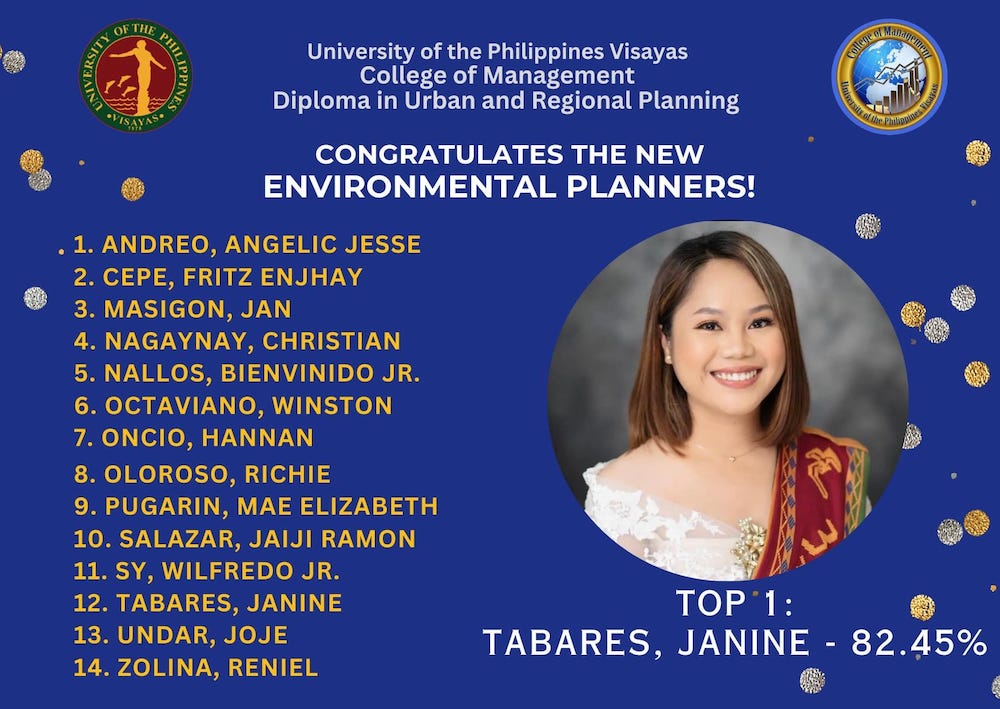
The College of Management of the University of the Philippines Visayas congratulates the fourteen (14) graduates of the Diploma in Urban and Regional Planning (DURP) Program, who are among the 115 passers in the July 2023 Environmental Planner Licensure Examination (EnPLE).
EnP Janine M. Tabares, a DURP graduate of UP Visayas, topped the examination with a rating of 82.45%.
The Professional Regulation Commission (PRC) conducts the annual EnPLE according to the provision of Republic Act 10587 (Environmental Planning Act of 2013) in regulating the practice of environmental planning in the country.
Source: https://www.upv.edu.ph/index.php/news/up-durp-grad-tops-annual-enple
UP Diliman grad tops landscape architect licensure exam
By Claire Bernadette Mondares
A graduate of the University of the Philippines-Diliman topped the Landscape Architect Licensure Examination given in July this year.
Albertene Manabat Aloc got a score of 80.75 percent.
The Professional Regulation Commission (PRC) said that 64 out 112 examinees passed.
The University of the Philippines-Diliman was the top performing school, getting a 100 percent passing rate.
The Landscape Architect board exam was conducted on July 19 to 20, 2023 in the National Capital Region and Cebu City.
For the issuance of professional ID and certificate, successful examinees were advised to apply online at https://online.prc.gov.ph/ on August 29 to August 30, 2023.
Source: https://www.manilatimes.net/2023/07/27/news/up-diliman-grad-tops-landscape-architect-licensure-exam
UP-Diliman grad tops July 2023 Licensure Examination for Landscape Architects
By GMA Integrated News
A graduate from the University of the Philippines – Diliman topped the Licensure Examination for Landscape Architects given earlier this month in the National Capital Region and Cebu, the Professional Regulation Commission (PRC) announced.
Albertene Manabat Aloc gained a percentage rating of 80.75, the highest among 64 examinees who successfully hurdled the examinations.
The members of the Board of Landscape Architecture who gave the licensure
examination are Paulo G. Alcazaren, Chairman, and member Cecilia H. Tence.
The PRC named UP- Diliman as the top performing school with all students who took the exam or 100 percent passed.
Click here for the complete list of passers.
Source: https://www.gmanetwork.com/news/topstories/nation/877045/up-diliman-tops-july-2023-licensure-examination-for-landscape-architects/story/
AI-powered Baybayin translator being developed by UP mathematicians
by Eunice Jean Patron, UPD-CS SciComm
Filipino mathematicians have just invented a computerized method for converting entire paragraphs and even full documents written in the ancient Filipino Baybayin writing system into text that even non-native readers can easily understand. And they’re now hard at work developing a full two-way translator.
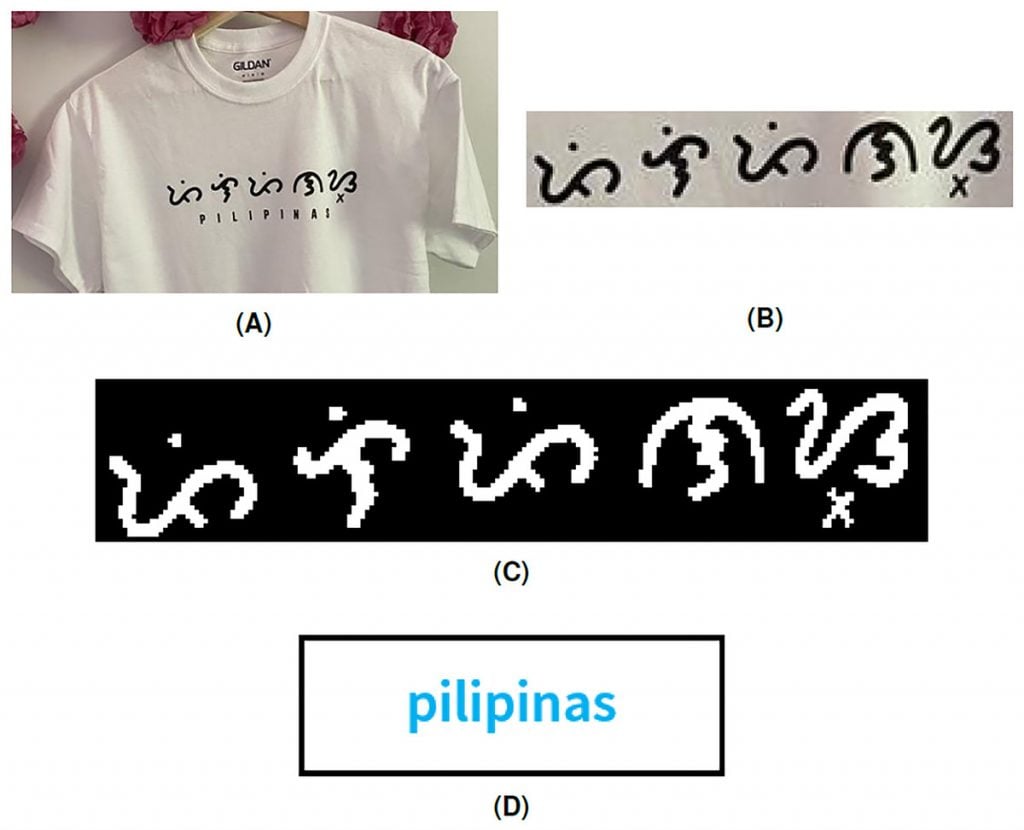
By combining mathematics and technology, scientists from the University of the Philippines – Diliman College of Science Institute of Mathematics (UPD-CS IM) have made what is likely the world’s first paragraph-level optical character recognition (OCR) system that can distinguish between entire blocks of Baybayin and Latin characters in a text image.
Thousands of images, months of hard work
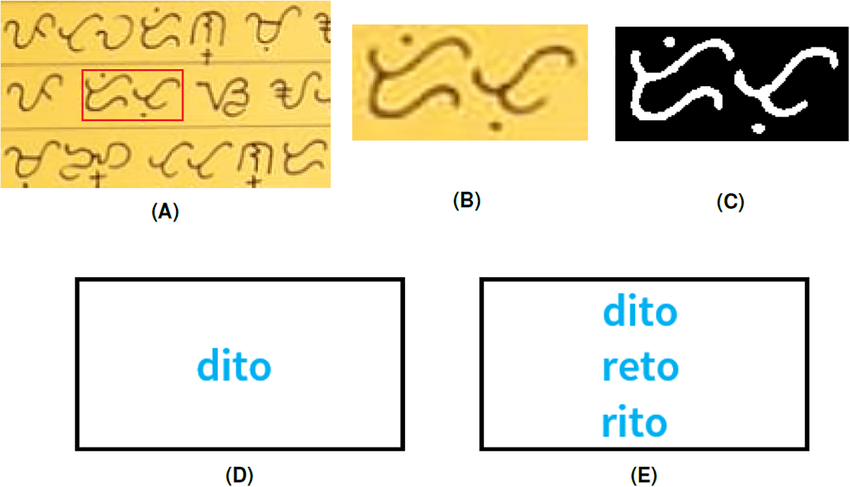
In their paper entitled “Block-level Optical Character Recognition System for Automatic Transliterations of Baybayin Texts Using Support Vector Machine,” masters student Rodney Pino and associate professors Dr. Renier Mendoza and Dr. Rachelle Sambayan developed an algorithm to convert a photograph of a set of text into binary data, which is then run through a support vector machine (SVM) character classifier to automatically determine whether the characters are Baybayin or Latin.
“SVM is a machine learning algorithm used to solve regression or classification problems,” Pino explained. “We have a dataset for Baybayin characters—let’s say character A and then character BA. SVM uses techniques or mathematical methods that can separate the two datasets to determine characters BA and A.”
It took the group more than three months to collect over a thousand images for each Baybayin character, gathering a total of 110 paragraphs from different websites that have either hand- or typewritten Baybayin, Latin, or Baybayin and Latin writing. “Adding more character images improves the recognition rate of SVM,” Pino explained.
Developing a smart, two-way translator
Currently, the OCR system can spell out the Latin equivalent of the Baybayin characters on a page, thus producing a transliterated version of the text. But the researchers are looking to enable it to do so much more.
The mathematicians also plan to make the OCR system more aware of the context of Baybayin words and phrases, possibly paving the way for a full-fledged translator. They are also trying to make the system work both ways, with the ability to convert Latin words with foreign sounds into Baybayin.
“We’re trying to refine the software we developed to make it easier for future users to navigate it. We also dream of creating a mobile application that automatically and accurately translates Baybayin characters just by hovering over the phone,” Dr. Mendoza said.
However, there are some kinks to smoothen out: Dr. Mendoza said that it was challenging to get the OCR system to translate Baybayin words and sentences accurately. “For now the system can’t distinguish between some Baybayin characters that are similar in writing, such as E and I, and O and U. We also have a lot of words that have different Latin equivalents,” he expounded. “The algorithm we used shows all possible translations of the Baybayin words.”
Preserving Filipino writing systems
Although still scant, interest in and research on Baybayin is slowly increasing, making the mathematicians hopeful that more Filipinos will become interested in protecting Baybayin through research. The team published their data to encourage more researchers to conduct studies on Baybayin and OCR. “We cleaned the data in such a way that researchers could use it in analyzing Baybayin through other algorithms,” Dr. Mendoza shared. “We made the data readily available for use, so researchers wouldn’t go through the difficulty we experienced in gathering data.”
Philippine traditional writing systems, such as Baybayin, are representations of Filipino tradition and national identity. As such, the country’s government officials created the “Philippine Indigenous and Traditional Writing Systems Act,” which seeks to promote, protect, and preserve Baybayin and other traditional writing systems.
The proposed law urges using Baybayin as a tool for cultural development and safeguarding, therefore encouraging organizations and institutions to spearhead activities and projects that promote awareness of these traditional writing systems.
According to the scientists, Baybayin is living proof that we Filipinos have our own technically-sophisticated traditions. While they aren’t putting forward making Baybayin the Philippines’ primary writing system, the group believes that conducting more research on Baybayin will help preserve this heritage. “This can be forgotten,” Dr. Sambayan said. “It’s important to have a record of each Baybayin character—even having digitized ones.”
Dr. Sambayan expressed concern that the number of Filipinos who can read and write Baybayin is decreasing, adding to the importance of identifying and translating Baybayin characters into Latin. “We’re hoping that through this OCR system, we could preserve and pass on the knowledge of understanding Baybayin to future Filipino generations,” she said.
Baybayin and other traditional writing systems are a part of the Philippines’ rich history. Several old Filipino documents are in Baybayin—documents that can uncover more information about Filipino culture. The scientists are encouraging more Filipinos to join them in cultivating the body of knowledge the country has on Baybayin. “Kapag walang gagawa nito, sinong gagawa? Even though its implication already has a bit of a niche, I think this is still a vital research venture,” Dr. Mendoza said.
For interview requests and other concerns, please contact [email protected].
Sources:
Pino, R., Mendoza, R., & Sambayan, R. (2022). Block-Level Optical Character Recognition System for Automatic Transliteration of Baybayin Texts using Support Vector Machine. Philippine Journal of Science, 151(1), 303-315.
Philippine Indigenous and Traditional Writing Systems Act, S. 1680, 19th Cong. (2022).